For a long time, digital visibility meant one thing — ranking on Google. You fought for position one, you wrote for the algorithm, and success was measured in blue-link clicks. That model is not dead, but it is no longer complete. A growing and irreversible shift is happening: people are getting answers from AI before they ever see a search results page.
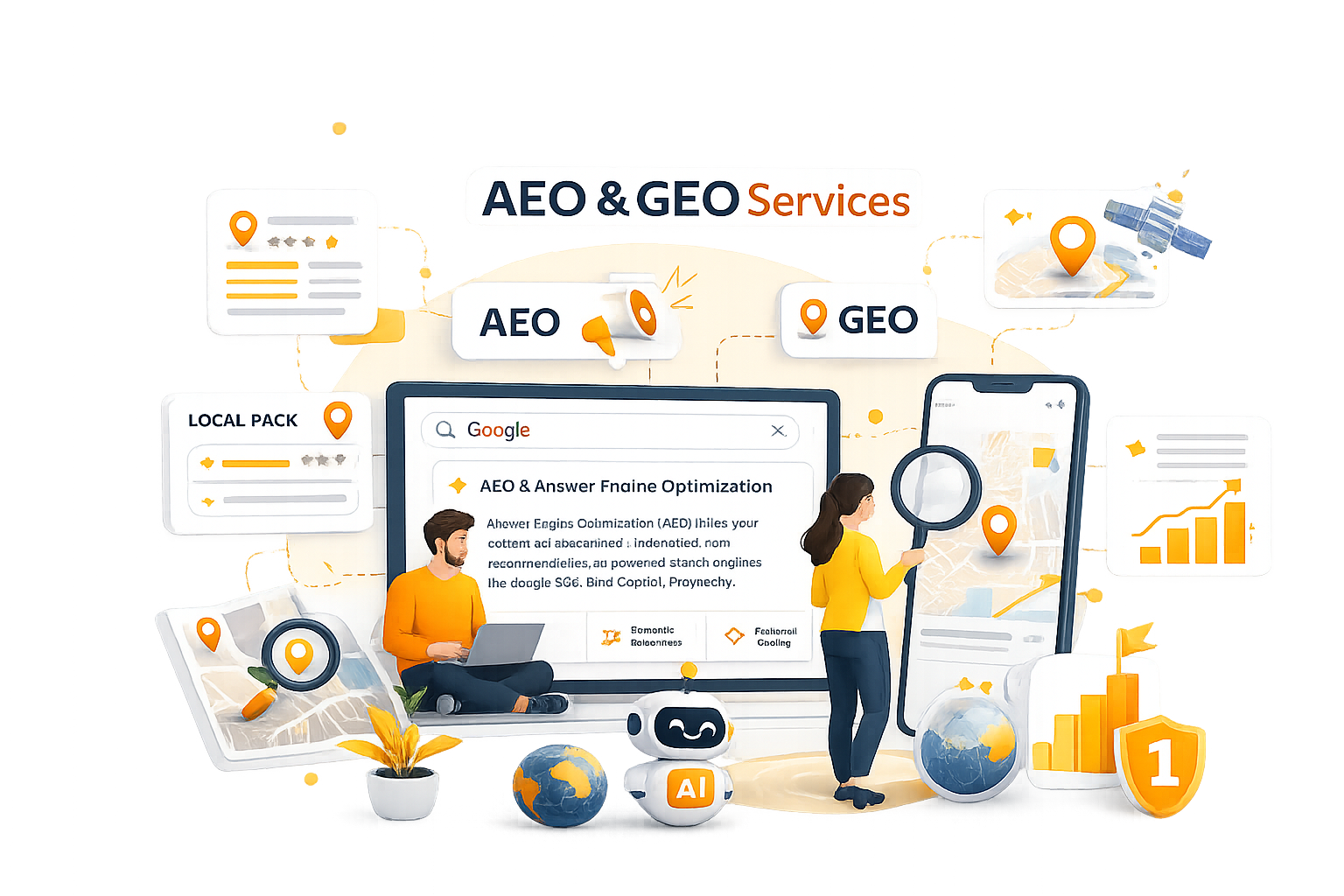
There are now two distinct ways a potential customer can discover your brand through AI. The first is a direct question — someone asks ChatGPT, Perplexity, or Google AI Overviews a specific question, and an AI produces one cited answer. The second is a generative context — someone asks an AI to compare, recommend, or summarise options in your category, and the AI generates its own narrative about who the relevant players are. These are the two disciplines we build for: AEO for the first, GEO for the second.
Most brands are currently invisible in both. Their structured data is incomplete. Their entity signals are weak. Their content is written for human scanners rather than machine comprehension. And their third-party footprint — the citations, mentions, and descriptions that AI models use to understand who you are — is either thin or inconsistent.
By 2026, over 60% of searches are ending without a click. The question is not whether AI discovery is happening in your category. The question is whether it is happening for you or for your competitors.

They work together but serve different parts of the AI discovery journey. Understanding the difference is what separates a targeted strategy from a generic one.
AEO is the practice of structuring your content and data so AI assistants pull your brand as the direct cited answer when a user asks a specific question. It is precise, measurable, and question-level.
GEO is the broader discipline of influencing how AI models represent, position, and recommend your brand in any generated content — comparisons, category summaries, and unprompted recommendations included.
These are not future trends. They are already shaping how buyers find and choose brands in every category.
Millions of high-intent queries that used to start on Google now start inside ChatGPT, Perplexity, or Gemini. The brand discovery funnel has a new entry point — and most businesses have no presence there at all.
When an AI tells a user that your brand is the answer to their question, that endorsement carries significant weight before the user has read a single word of your own marketing. The trust is established upstream of your website entirely.
Over 60% of searches now end without a user clicking through to any website. If your visibility strategy depends entirely on clicks, you are already invisible to the majority of people asking questions in your category.
AI citation is not a pay-to-play channel. It compounds with time — the brands that build authority, structured signals, and citation networks early will become the default recommendations in their category as the technology matures.
Every major AI assistant has already formed a representation of your brand based on everything it was trained on. If you have never optimised for this, that representation is shaped entirely by chance — whatever happened to be indexed — not by the story you want to tell.
AI answer engines don't automatically defer to brand size or domain authority. A smaller brand with sharper entity signals, cleaner structured data, and better answer-ready content can be cited ahead of a much larger competitor on the same query.
Everything that goes into making your brand the one AI systems choose to cite, recommend, and describe positively — executed as a single unified programme.
Before any optimisation begins, we test how your brand currently appears — or fails to appear — across ChatGPT, Perplexity, Google AI Overviews, and Gemini for the specific questions your customers are asking. We also map your named competitors' current citation share for those same queries, so you know exactly what gap you are starting from and what is required to close it.
AI models understand the world through entities — named things with properties, relationships, and identifiers. Your brand, your services, your founders, and your location are all entities. If those entities are poorly defined, inconsistently described, or absent from the web graphs that LLMs draw from, the AI doesn't know what to do with you. We build a coherent, consistent entity presence across your own site, structured data, and third-party references so every major AI system recognises exactly who you are.
AI systems prefer to cite content that is written in clear, direct, question-and-answer structures — not long-form articles built around keyword density. We audit your existing content, identify the highest-value queries your brand should be answering, and either restructure existing pages or create new content in the exact format that large language models lift and quote. This includes FAQ blocks, definition paragraphs, concise service descriptions, and structured comparison sections.
AI models do not only draw from your own website. They also draw heavily from what others say about you — directories, press coverage, review platforms, industry publications, and professional databases. The density and quality of your third-party citation network directly shapes how confident an AI is in citing your brand. We build that network deliberately, targeting the specific platforms and publication types that AI crawlers already treat as high-authority reference points.
This is the layer most agencies don't offer because it requires genuinely understanding how large language models form and update their representations of brands. We analyse how your brand is currently described in AI-generated content — what adjectives are used, how it is positioned relative to competitors, what claims are made — and build a targeted strategy to shift that narrative through structured content, consistent messaging, and strategic placement across the sources LLMs draw from.
Even the best-structured content cannot be cited if AI crawlers can't reach or read it. We audit your technical setup — robots.txt configuration, llms.txt implementation, JavaScript rendering behaviour, page speed, and crawl budget — and ensure the platforms that power AI answers have clean, frictionless access to every page that matters. We also implement and validate all relevant schema types: Organisation, FAQPage, Service, Article, Product, and LocalBusiness as applicable.
Unlike traditional SEO where rank tracking is automated and instant, AEO and GEO measurement requires systematic prompt testing across multiple platforms. We run defined query sets monthly across ChatGPT, Perplexity, Google AI Overviews, Gemini, and Microsoft Copilot, track which brands are cited and how, monitor AI-platform referral traffic in your analytics, and deliver a clear monthly report that shows your citation share against named competitors.
From the moment a buyer opens an AI assistant to the moment they visit your site, there are four places your brand can either show up or get replaced by a competitor.
A buyer types a question into ChatGPT, Perplexity, or Gemini — "best [service] in [city]", "how do I solve [problem]", or "compare [category] options". This is the moment that determines everything that follows.
The AI retrieves structured content, third-party mentions, entity data, and web pages it trusts. Brands with weak structured presence, poor entity signals, or blocked crawlers are skipped entirely at this stage.
The AI synthesises a response — either citing specific sources directly (AEO wins here) or generating a narrative about the category and who the key players are (GEO wins here). Your brand either appears or it doesn't.
The buyer now has a named brand, a description of what it does, and a reason to trust it — all before visiting any website. The brands that appear here have a head start that no amount of on-site optimisation can replicate.
Understanding this is the difference between optimising with intent and optimising by guesswork.
Large language models do not discover your brand fresh each time someone asks a question. By the time a query is processed, the model already has an internal representation of your brand — a kind of probabilistic memory built from everything it has seen about you across training data and real-time retrieval. That representation determines how likely it is to include you, how positively it describes you, and how confidently it cites you.
This representation is formed from a specific set of signals. Some of these come from your own website — how your content is structured, how clearly you define what you do, and what schema markup you have implemented. But a substantial portion comes from what the rest of the web says about you: press coverage, directory listings, review platforms, social profiles, industry publications, and the language used by third parties when they mention your brand.
When those signals are consistent, specific, and present across multiple trusted sources, the model's internal representation of your brand is clear and confident. When they are weak, inconsistent, or absent, the model defaults to uncertainty — and uncertain brands don't get cited.

Brands that run AEO and GEO simultaneously see compounding returns. AEO builds the precise citation signals that give AI confidence. GEO builds the broader narrative context that makes those citations feel consistent and credible. Together they create a brand presence in AI systems that is both specific enough to answer individual questions and broad enough to win category-level comparisons.
Straight answers to the questions we hear most from brands exploring AI search optimisation for the first time.
Generative Engine Optimization is the practice of shaping how AI systems represent, describe, and recommend your brand whenever they generate responses about your category, market, or topic. Unlike AEO, which targets specific cited answers to specific questions, GEO covers the entire surface area of how AI talks about your brand — including comparisons, category summaries, recommendation lists, and narrative descriptions where no specific question about your brand was even asked.
AEO is question-level and citation-specific: a user asks a precise question and your brand is cited as the direct answer. Measurement is clear — either you are cited or you are not, for a given query, on a given platform. GEO is broader and narrative-level: it shapes how AI models describe your brand in any generated content, whether a direct question was asked or not. Both matter, and they work best when run together because they address different parts of the same AI discovery journey.
Because AI discovery happens in two ways. Sometimes a user asks a specific question and wants a directly cited answer — that's where AEO wins. Other times a user asks the AI to recommend, compare, or summarise options in your category, and the AI generates its own narrative without a specific source being cited — that's where GEO matters. A brand that optimises only for AEO appears for specific questions but may be absent from category-level comparisons. A brand that optimises only for GEO builds general reputation signals but may lose specific high-intent queries to competitors who have sharper AEO foundations.
AI models form an internal representation of your brand from every source they have processed — your website, press coverage, reviews, social mentions, and third-party descriptions. GEO works by improving the quality, consistency, and authority of those signals. The clearer and more consistent your brand's description is across authoritative sources, the more accurately and positively AI models describe you when generating comparison content. If you have never done GEO work, what AI says about you in a comparison is entirely shaped by chance — whatever happened to be indexed about you.
Yes, in most cases. If an AI model is generating descriptions of your brand that are outdated, incomplete, or inaccurate, GEO strategies address this by strengthening and updating the authoritative signals the model draws from. This includes structured data updates, content refreshes on key pages, new high-quality third-party placements, and targeted entity corrections. The timeline depends on how deeply the existing incorrect signals are embedded across the web — but it is usually addressable within three to six months of consistent GEO work.
Yes — significantly. The technical foundations of AEO and GEO overlap substantially with strong traditional SEO practice. Structured data, entity clarity, clear content structure, fast rendering, and a strong third-party citation network all benefit your traditional search rankings as well as your AI citation performance. Running both in parallel does not require double the effort — it requires a unified strategy that addresses both audiences simultaneously. Brands that start with a strong SEO foundation adapt to AEO and GEO far faster than those starting from scratch.
AI optimisation performs best when it sits on top of a complete digital presence. Explore what our clients pair it with.
The question-specific citation layer: getting cited as the direct answer inside AI assistants for high-intent queries.
Learn MoreThe technical and on-page foundation that both AEO and GEO depend on. Pages that rank also get cited.
Learn MoreDeep, answer-ready content gives AI systems more source material to draw on and cite with confidence.
Learn MoreSee exactly where you stand across ChatGPT, Perplexity, and Google AI Overviews right now — at no cost.
Get Started